
Since their week 6 bye, the Eagles offense has taken a huge step forward.
Saquon Barkley looks like the best running back in football. They’re the No. 1 rushing attack in the NFL (199.7 yards per game). The rushing attack looks dominant.
They’re averaging 389.8 total yards per game, and they’ve put up 28.8 points per game.
But there’s something missing.
The Eagles passing offense ranks 16th in DVOA, which measures team success based on each play’s down and distance in comparison to the rest of the league.
In total, Philadelphia’s passing offense ranks 22nd in the NFL. It isn’t a stretch to say that more should be expected of the unit.
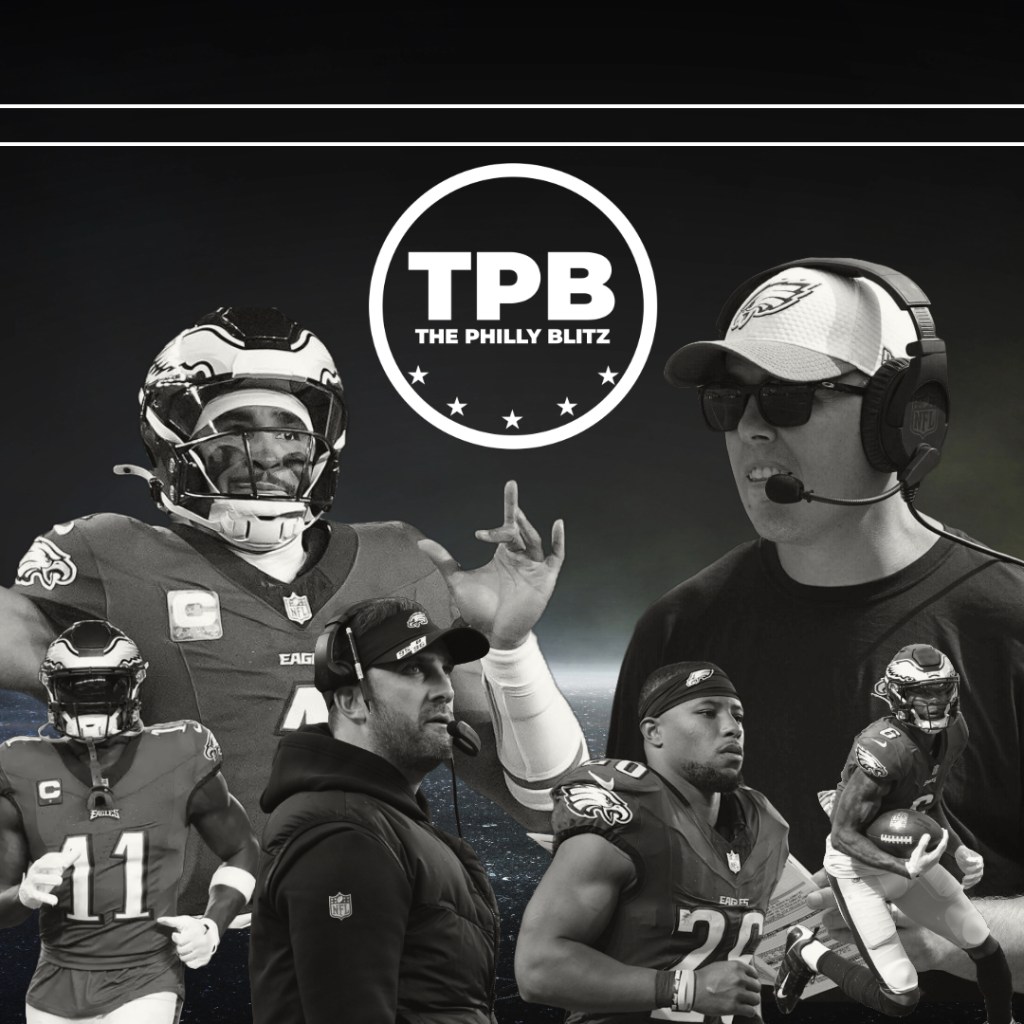
The offense, which features the aforementioned Barkley, superstar quarterback Jalen Hurts, All-Pro wideout A.J. Brown, Heisman winner and former 1st-round pick DeVonta Smith, veteran tight end Dallas Goedert, former 1st-round pick Jahan Dotson, and an offensive line that ranks 2nd in pass block win rate (per ESPN), has displayed flashes of brilliance throughout the season, but it has struggled to maintain consistency on a week-to-week basis.
And make no mistake, it doesn’t have to be looked at as if the passing game isn’t working; it’s more so about creating rhythm and establishing some consistency in their approach as a passing offense.
Some of that inconsistency can be chalked up to an expected drop-off due to the offense becoming more run-centric in the wake of a historic season from Saquon Barkley, but the passing attack has left a lot to be desired.
Also, as a bit of a caveat, some of that same inconsistency can be chalked up to the fact that the offense hasn’t had the time to gel together with on-field reps in every game this season (A.J. Brown has missed 3 games this season, DeVonta Smith has missed a game, Dallas Goedert has missed multiple games this season, and the offensive line has dealt with injuries to several starters this season).
Throughout the 2024 season, it’s often felt like the Eagles passing offense has been an amalgamation of isolated one-on-one routes that don’t necessarily complement or build off of one another.
Essentially, at times this season, the Eagles offense has morphed back into the 2023 philosophy of ‘our players are better than yours’ approach that is overly reliant on talent over scheme.
It makes sense to think that way when you’re as talented as the Eagles are on offense. You’d expect A.J. Brown and/or DeVonta Smith to win their one-on-ones regardless of what coverage shell they’re facing, but coaching matters too.
By being overly reliant on the talent of your star players and depending on one player to win, it puts your quarterback and offense as a whole at a disadvantage.
So that begs the question: What do they need to do to get the passing offense on track?
I think it starts with leaning on the strengths of your players, and for the Eagles, that starts with a few things:
- Utilizing progression reads and marrying concepts together
- Leaning on the quick passing game
- Structuring the passing offense by how teams are defending you
Opposing defenses aren’t blitzing the Eagles at the same rate as they did last season (36% this year compared to 40% last year through ten games), but when you consider the skillset of a receiver like A.J. Brown and the success Jalen Hurts has had this season when throwing over the middle of the field on crossing routes, drag routes, slants, among other in-breaking routes, it puts your offense in an advantageous position.
This season, when the Eagles have operated in the quick passing game and gotten the ball into their receivers hands with room for them to create, they’ve looked at their best as a unit.
When throwing over the middle of the field, Jalen Hurts has the 2nd highest EPA per attempt at 0.47 (behind Lamar Jackson – 0.61).
This plays into the next point of structuring the passing offense off of how teams are defending them.
Saquon Barkley demands attention. He’s a player that defenses have to account for when he’s on the field.
Because of this, teams have two options. They can load the box and sell out to stop the run, or they can devote more attention to stopping the Eagles passing game. Essentially, for the Eagles offense, it’s about putting the opposing defense in conflict, and it’s easier for them to do more than most teams because of the star-studded offense that they possess.
The Eagles are a run-first team right now. And when you have a running back that’s averaging 5.8 yards per carry and he’s a legit threat to score whenever he touches the ball, along with an offensive line that takes pride in mauling defense, it makes sense that you’d want to lean on your rushing attack.
At the same time, that doesn’t mean neglecting the passing offense and making yourself one-dimensional is the solution. It’s about capitalizing in the passing game off of the way defenses are playing your running game.
And again, because of the star power on this offense, it’s easier for the Eagles to do so than most teams.
A major way to do that for Philadelphia is also by utilizing the play-action passing game, which the Eagles have done at a very high rate since returning from the bye week.
Per dropback from weeks 8-11, the Eagles utilize the play action passing game at the 5th highest rate in the league, and they’ve been successful when doing so.
Throughout the first few weeks of the season, the Eagles were at the top of the league in first down run percentage. They ran the ball at one of the highest rates in the league on first downs. They faced a lot of light boxes because the opposing defense knew their passing game was focused on hunting explosives downfield.
Now, since the bye week, as they’ve shown the ability to run the ball, teams are now loading the box (i.e., selling out to stop the run), and the Eagles are making them pay with their use of the play action passing game (both under center and out of pistol/shotgun), and they’re succeeding.
And they’re able to do so because of the threat that Barkley is (and how teams defend him).
But the most important factor that ties all of these elements together is utilizing pure progression reads.
Essentially, it’s marrying concepts together and allowing Jalen Hurts and Kellen Moore to find synergy between what the design of the play is and where the ball is supposed to go.
And they’ve shown the ability to do so on concepts like this post-cross concept against the Saints.
Or this post-wheel concept (similar to the touchdown early in the season vs. the Packers).
Essentially, it’s designing plays and marrying things together that force the defense to defend concepts rather than just isolated players. This also allows for Hurts to go through reads rather than just hunting explosives downfield.
And the thing with this is, it doesn’t have to be as static as hunting downfield explosives, which again are mostly isolated deep shots. These tie everything together. They can be done out of shotgun, out of pistol, off of play action, and from under center.
The Eagles are an 8-2 football team. By beating the Washington Commanders last week, they’re in full control of their playoff destiny (as things currently stand). They currently possess the league’s best defense and number one rushing attack.
However, the passing offense remains the one area that can be improved. While the potential is clear and the vision is in place, there’s room for more consistency and synergy.
The Eagles have shown flashes of what they can do, but they haven’t yet put it all together on a week-to-week basis.
They’ve proven they can be dynamic and multiple; now it’s about tying all these strengths together and making everything consistent as the season trudges along and the NFC playoff picture tapes shape.
Cover Image Credit: The Philly Blitz Media

 The Philly Blitz
Leave a comment