

“We’re not on the same page, man. We’re just not rushing together.”
That was Eagles EDGE Josh Sweat after the Eagles week 2 loss to the Atlanta Falcons.
Atlanta utilized 11 personnel (one running back, one tight end) on almost every offensive snap and the Eagles matched it with nickel (4 down linemen, 2 linebackers, and 5 defensive backs). The Falcons ran all over the Eagles defense.
Atlanta ran for 152 yards and amassed 5.4 yards per carry.
Over the first two games of the 2024 season, the Eagles allowed 315 rushing yards and a league worst 6.4 yards per carry.
Heading into Sunday’s matchup the Saints, New Orleans had averaged 185 rushing yards per game. They had boat raced both the Panthers (week 1) and Cowboys (week 2), averaging 45.5 points through two games.
And they had done so primarily through the use of their zone running game, which new offensive coordinator Klay Kubiak brought to New Orleans from his time under Kyle Shanahan (as well as the roots of the system being tied back to Kyle’s father, Mike Shanahan and Klint’s father, Gary Kubiak).
The origins of the system date all the way back to 1994 when Mike (offensive coordinator) and Gary (Quarterbacks coach) led the San Fransisco 49ers’ top-ranked offense to a Super Bowl.
Around this time, a former USFL defensive assistant was getting his start in the NFL, with those same New Orleans Saints.
Vic Fangio was the Saints linebacker coach from 1986-94.
Fangio has faced off against the Shanahan-Kubiak offense numerous times, against both fathers and sons. And one thing that each generation and branch from the tree of the Shanahan-Kubiak offense have agreed on is, Fangio is one of (if not THE) toughest defensive system to face.
So when the Eagles prepared to face off against the Saints on Sunday, it would be yet another chapter in the battle. And Fangio had Philadelphia ready.
At it’s core, the Shanahan-Kubiak zone running offense aims to overwhelm defenses by winning with timing, window dressing/misdirection, angles, being multiple, and the numbers game. They then mix in the play action passing game off of this.
Coming into Sunday’s matchup, the Saints had utilized all of these same elements, but how they arrived at their desired destination differed.
New Orleans came into Sunday’s matchup utilizing 11 personnel at the 4th lowest rate in the NFL through 2 games. They utilize a ton of heavy condensed 12 personnel (2 tight ends), 21 personnel (2 RBs – 1 TE – 2 WRs), and 22 personnel (2 RBs – 2 TEs – 1 WR) sets.
And what they’ve been able to do out of each of these different personnel groupings is entirely dependent upon the players they have on the field.
Simply put, the offense is extremely multiple. They use condensed sets to manipulate opposing offenses. They use pre-snap motion and window dressing to make defenses overcompensate and overwhelm them. They use the numbers game to out leverage offenses.
In order to combat this, instead of playing the same nickel fronts that had gotten them torched in the 2 weeks prior, Fangio decided to dial the clock back to 2018 when he faced Shanahan-Kubiak disciple Sean McVay and the Rams high powered zone running attack.
Fangio utilized a 6-1 front with 4 down linemen, a stand up backer and a DB aligned off/near the other edge along with a 2-high shell over the top of the defense. The result was Fangio’s defense holding the number 2 scoring offense to just 6 points.
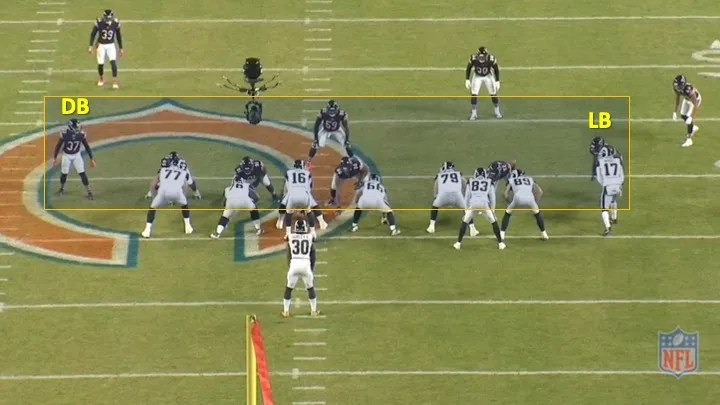
On Sunday, Fangio fired up the band again.
Against these zone offenses, the normal thought process for most teams is to just load the box by inserting a third linebacker or bringing a safety down into the box.
The thinking there is to load the box so you’re even from a numbers perspective, but by doing it this way, you’re out leveraged and it’s easier for offensive linemen to climb to the second level and wash the linebackers (or safety who comes down) out of the play.
Not to mention you’re also more suceptible to the deep play action pass game because, again you’re out-manned from a numbers and coverage perspective because the entire offensive system is built around mis-direction, timing, and window dressing.
Fangio and the Eagles loaded the box by loading the defensive line. They also stayed in 2-high to combat the threat of the deep play action pass game.
Fangio essentially matched heavy sets by Kubiak with heavy fronts of his own. Philadelphia had 5 or more defensive linemen on the field on 27 out of their 56 total defensive snaps.
Most of their 5 man looks also came on early downs, which are prime running downs that the Shanahan-Kubiak offenses use outside zone runs to set up the play action passing game (again remember, Fangio also made sure to keep the 2 high shell over the top of the defense to combat this.)
Fangio ruled the day with heavy 5 and 6 man fronts to combat the condensed sets that the Saints typically execute their offense out of, and Kubiak had no answer. So much so that through 3 quarters, New Orleans didn’t even have 100 total yards of offense.
At it’s core, the Fangio defensive system is a true team based defense. Each part is fundamentally connected to the other and it was on full display on Sunday. Philadelphia’s outside linebackers rushers did a good job of setting the edge and funneling runs back inside for Nakobe Dean to scrape and fit runs in the 5-1 and 5-2 fronts.
The defensive tackles also routinely took on double teams which allowed for one on ones elsewhere.
Fangio also did window dressing of his own, but the reasoning for it is the most interesting part. When Fangio faces these zone based offenses, his thinking is to sit back and let all of the offenses smoke and mirrors window dressing take place. Essentially, letting them declare and then from there the defense goes. It’s why Zack Baun was so important on Sunday.
As stated, Fangio had some window dressing and smoke and mirrors of his own. Some of this included things like the play shown above, but it also includes utilizing the versatility of the personnel that’s at his disposal.
For example, using players like Milton Williams at EDGE, Brandon Graham being kicked inside presented multiple looks to the Saints offense (each has the ability to slide over from a 3T to 5T to 7T to 5T), as well as Zack Baun who can play off ball and slide down as a standup EDGE rusher.
Fangio also utilized nickel corner Avonte Maddox as a pseudo OLB (it’s interesting when you think back to Fangio referencing the nickel corner position as a psuedo linebacker in his system which then brings you back to the selection of Cooper DeJean).
It feels a lot like positionless football.
It also helps when you have a force who is as dominant as Jalen Carter who flat out wrecked the game on Sunday. And don’t forget, you also have a 340-pound gravatational force of nature in Jordan Davis who had the first sack of his 2024 campaign on Sunday.
Sunday’s matchup offered a glimpse into the core elements of the Fangio defense: adaptability, adjustments, versatility and execution.
Philadelphia was coming off a game in which the defense failed to stop an Atlanta Falcons zone offense that was similar to the one they were about to face, and they were heading into a game matched up with the NFL’s top scoring offense in one of the toughest environments to play in in the league.
And they held held the Saints to just 12 points, 89 total rushing yards (3.1 yards per carry) and just 213 yards of total offense.
Philadelphia came into this matchup reeling. They’d allowed the most yards per carry in the NFL (6.4). They ranked last in run defense DVOA. They’d heard the chatter and criticism from local and national media, in the words of Nick Sirianni, “we’ve heard everything.”
And they responded.
Cover Image Credit: Stephen Lew/Imagn Images


 The Philly Blitz
Leave a comment