
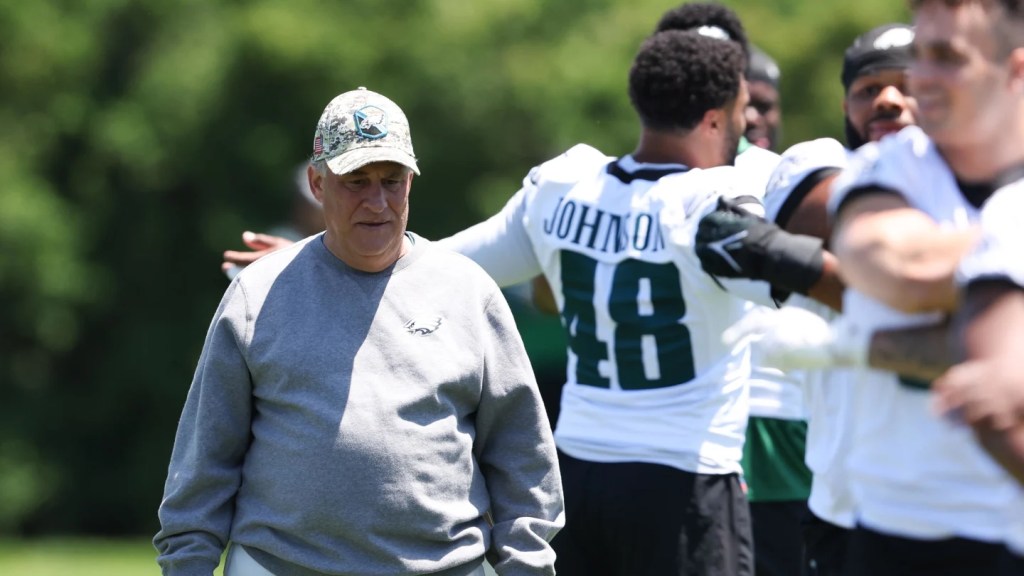
The Eagles organization has been enamored with the Vic Fangio defensive system for what feels like an eternity.
From the moment Nick Sirianni was hired as the franchise’s 21st head coach, they’ve run some iteration of the Fangio system, or at least philosophically speaking, they’ve been committed to it.
When the team hired Jonathan Gannon in 2021, the common refrain heard amongst fans and media alike was the emphasis that Gannon (like Fangio) placed on limiting explosive plays.
At its core, the crux of Fangio’s philosophy is much of the same, with the main difference between Gannon and Fangio being Gannon’s heavy usage of true cover 4 coverage shells with quarters concepts on both sides of the field, while Fangio prefers more split field, two high structures, but with heavy cover 6 usage.
Essentially, the thinking between the two coaches is similar, but the manner in which each coach arrives at their destination differs.
Gannon would become the head coach of the Arizona Cardinals, and Fangio, who worked with the Eagles in a consultant role in 2022, was expected to become the franchise’s next defensive coordinator.
However, by the time Philadelphia learned Gannon was taking the Arizona job, Fangio had taken the defensive coordinator position with the Dolphins.
Meanwhile, Philadelphia dove even deeper into the Fangio well when they hired Fangio disciple and protege Sean Desai.
According to Sports Illustrated, Fangio, who worked with the Eagles in an advisory role in 2022, even recommended Desai to Nick Sirianni.
Desai, who coached under Fangio from 2015 to 2018 with the Chicago Bears, implemented a ton of Fangio-esque principles, but inconsistencies, miscommunication both on and off the field, injuries, and inexperience, among other factors, doomed him from the start.
The team struggled after starting 10-1 and following two blowout losses to the 49ers and Cowboys in back-to-back weeks, the axe fell on Desai. He was stripped of play-calling duties during the Eagles Week 10 bye week.
According to a Dec. 16 report from The Athletic, former Eagles safety Kevin Byard “approached Desai privately and pitched the defensive coordinator a plan for the defensive backs to put together a scouting report of the Seahawks because of the Eagles’ recent disastrous losses.”
For a team that was in the Super Bowl the year prior, Desai, who was seemingly working to find his footing and learn on the fly, just wasn’t the right match for Philadelphia.
Former Lions head coach Matt Patricia would take over, and the unit would enter a free fall, losing six of their last seven games and being absolutely massacred in the first round of the playoffs by the Tampa Bay Buccaneers. Under Patricia, Philadelphia gave up 27.8 points per game along with 327.2 yards per game.
The Eagles allowed the third most points per game during the regular season, ranked 30th in redzone and third down defense, and gave up 35 passing touchdowns (the most in the NFL) in 2023.
Fast forward a few months, and the Eagles would move on from both Patricia and Desai following the 2023 season. On the other side, while Fangio’s one-year tenure with the Dolphins yielded some positive results, the marriage between the two just didn’t work.
The two sides would agree to mutually part ways following the 2023 season due to a combination of philosophical differences and challenges in developing an effective rapport with players on the Dolphins defense. Miami’s defense under Fangio ranked 10th in total defense while also dealing with a bevy of injuries to key players such as CB Jalen Ramsey, S Jevon Holland, DE Jaelan Phillips, and LB Bradley Chubb.
But where would Fangio ultimately land?
The place he admittedly wanted to be from the start.
“I think that’s a fair assumption,” Fangio said when asked whether he would have joined the Eagles staff the year prior had the timing worked out differently.
Fangio is widely regarded as the Godfather of modern NFL defenses. Look anywhere across the NFL and you’ll see some iteration of the Fangio two-high structure system.
As stated, Fangio’s system is focused on eliminating explosive pass plays. That ideology has spread through the NFL like wildfire, but there are a few things that separate Fangio from the bunch.
Most of the emulators of his system: 1) don’t have the years of coaching experience that he (Fangio) does; and 2) aren’t as innovative or adaptive as he is in terms of their coverage calls.
In the simplest of terms, the Fangio system aims to depict the illusion of simplicity to opposing quarterbacks pre-snap, while in actuality, it is quite complex post-snap.
With over 40 years of coaching experience, Fangio is bringing the one thing that the Eagles coaching staff as a whole lacked in 2023: a true veteran presence.
At its core, the Fangio base coverage is Cover 6, which, in the simplest of terms, combines Cover 4 and Cover 2. But it gets MUCH deeper than that (much deeper than I can go into detail on at the moment). Of course, with different packages, fronts, and formations, there are coverage calls that are even more complex than what’s mentioned above. For more information on that, check out ‘The Book of Fangio’ by Shawn Syed.
The two deep safety/light box defensive structure can morph into a bevy of coverages post-snap (Cover 1, Cover 4, Cover 6, Cover 8, Cover 9, to name a few).
For Fangio, the goal is to give off the illusion of simplicity pre-snap while morphing into an incredibly complex and difficult-to-decipher system for opposing quarterbacks post-snap.
This allows for a ton of flexibility in the secondary. This is why, if you’ve been following along as the Eagles offseason has progressed, the organization has placed a premium on the versatility of the players they’ve brought in (both in free agency and the draft).
Players like DB Chauncey Gardner-Johnson, CB Cooper DeJean, LB Zack Baun, and even DB Avonte Maddox, who the team recently brought back after releasing, all fit the mold of players who are hand-in-glove fits for Fangio’s system because they provide versatility both in skill set and position.
As stated, the goal for Fangio is to appear static or mundane pre-snap but complex and versatile post-snap.
“We have a system that is versatile, we like to think,” Fangio said. “It needs to be versatile because every week you’re facing different strengths of an offense, different schemes. So, what you play in one week (for) 10, 15 times, you may not play at all the next week. You have to have a versatile system for the offenses today in the NFL. What we’ll eventually do is learn what our guys are best at.”
“I like to throw a lot at them early because I think one of the worst things you can do is come Week 3, Week 5, ‘Man, we could really use this scheme,’ but it hadn’t been introduced to the players yet. Whereas if you introduced it to them in training camp and worked on it, when you pull it back out three, four weeks later, there’s recall. We’ll throw a lot at them in training camp to see what best fits for them, what they’re good at, and then try and whittle it down, but always keeping some stuff in the bank in case we need it at some point during the season.”
Having smart and versatile chess piece-type players who can do a bit of everything in the secondary makes it easy to disguise, bluff, and add little wrinkles or nuances to coverage calls under the guise of mundanity.
But it’s the first part that truly matters for Fangio.
“There’s a lot of players that physically are capable of being versatile,” Fangio said when he met with the media a handful of weeks ago.
“Where a lot of them get eliminated from being versatile is they struggle to learn the assignments and the techniques and the execution at a couple different positions. There’s a lot of guys that are versatile physically, but can’t do it mentally,” he continued.
This will likely be the biggest difference between the last few years and the upcoming season. The mental aspect of the game will matter much more.
Just listen to Eagles players from the first few days of OTA practices and mini-camp.
“I really think that last year, we didn’t have all the right coaches in the right position, I would say,” veteran Brandon Graham said.
“So far, I’ve gotten a great impression of him (Fangio), he’s throwing a lot at us right now,” Devin White said.
“No bulls—,” Jordan Davis said. “There’s no bulls—. Hope y’all can bleep that out. But there’s really no BS. It’s straight ball.”
“He’s an old-school coach. And I definitely like that about him,” Kelee Ringo said. “He’s got his strategies, his scheme, the way he coaches, and I like that he sticks to that. All of us are ready to buy into that.”
If you look around the Eagles defense, the unit has seemingly been built for this specific system. Keep in mind, Fangio was the presumed replacement for Jonathan Gannon, who again, like Fangio, designed his defensive scheme in an effort to limit explosive plays.
On the back end, the Eagles selected two cornerbacks in the first two rounds of the NFL draft who tailor made for Fangio’s system: Quinyon Mitchell and Cooper DeJean.
They also selected Kelee Ringo in the 4th round of the draft in 2023. Ringo’s traits and measurbles make him an enticing piece for Fangio, who as stated, is huge on disguise and multiplicity.
Ringo’s combo of instincts, size, and speed makes him applicable for usage in man coverage or zone. His willingness to come down and be physical in run support only adds to his appeal in Fangio’s system, which (against the run) aims to funnel runners to the linebackers at the 2nd level and outside, where defensive backs can come in and help.
Mitchell’s instincts are off the charts. He’s at his best when he can keep his eyes on what’s happening in front of him, read and understand the route concepts, click and close, and make plays on the football.
DeJean’s IQ, versatility, and technique are the biggest selling points of the Iowa product. He can play inside or outside.
In terms of defensive tackles, Fangio has worked with players like Akeem Hicks, Christian Wilkins, and Justin Smith in the past. For a player who’s as talented as the Eagles second-year defensive tackle, Jalen Carter, this should be music to his ears. Specifically, how Christian Wilkins was used under Fangio last season, which led to him having a career year in his first year in the system.
Against the run, the interior defensive linemen don’t necessarily attack up the field, instead opting to play a gap and a half and clog up space (eyes on you, Jordan Davis). What this means is that they play their gap, but they also have to play under control (and with discipline) in the event that they have to defend a secondary gap.
This is done in order to keep the linebackers at the second level clean against the run and get depth in pass coverage. This is why range and athleticism at the position are so important at the inside linebacker position in this scheme.
Philadelphia added a linebacker in Devin White, whose athletic traits pop off the screen when watching him. With his range, penetration ability in the run game, and overall explosiveness, the signing of White makes a ton of sense for this defense.
The outside linebackers are usually standup backers who work to rush the passer and set the edge while also being asked to drop into coverage at times (yes, that will happen a lot under Fangio). This is done with the idea of disguising and being as multiple as possible.
The team moved on from Haason Reddick, trading him to the Jets, and signed former Jets pass rusher Bryce Huff, whose fit in Fangio’s scheme is almost perfect.
Fangio’s system requires defensive ends/OLBs to be edge setters in base sets, possess pass rush ability in nickel and other sub-packages, and drop into coverage on occasion, all of which are things Huff has had success with over the course of his career. It’s just a question of whether or not he can do all these things as an every-down pass rusher and not a third-down specialist.
In addition to utilizing them as standup rushers, Fangio also sometimes utilizes his quicker or smaller outside linebackers on creepers or simulated pressures. Here, the 2023 selection of Nolan Smith, the signing of Zack Baun, and the recent 3rd round selection of Jalyx Hunt all come to mind.
Specifically, Smith, who thrived in a similar defensive scheme under Kirby Smart, should benefit greatly from the addition of Fangio.
Simply put, the Eagles are no longer emulating another coach’s rendition of the Fangio system.
Compared to the last few seasons, when the defense either lacked the discipline or communication needed to be successful or the unit struggled from a technique standpoint, now they have the original. It’s not a knockoff or imitation. Fangio isn’t the one chasing the trend or the next iteration of this defense. He is THE trend-setter.
As we draw closer to training camp, which begins next month, that’s something that should excite Eagles fans.
Cover Image Credit: Bill Streicher-USA TODAY Sports



 The Philly Blitz
Leave a comment